Where is the European Union heading? A Policy Position Map on Social Media Regulation for Youth
 Marcello Verona
The debate about young people and social media tends to be reduced to a single question: to ban or not to ban, when the real political landscape offers more than just two options and positions. This policy position map outlines thirty-one jurisdictions across four broad areas where the debate is currently taking place, plus a fifth relating to state control, where only China is included. On the horizontal axis, one can see approaches that are more or less oriented towards a “ban,” whilst on the vertical axis, one can see the maturity of the legislative process.
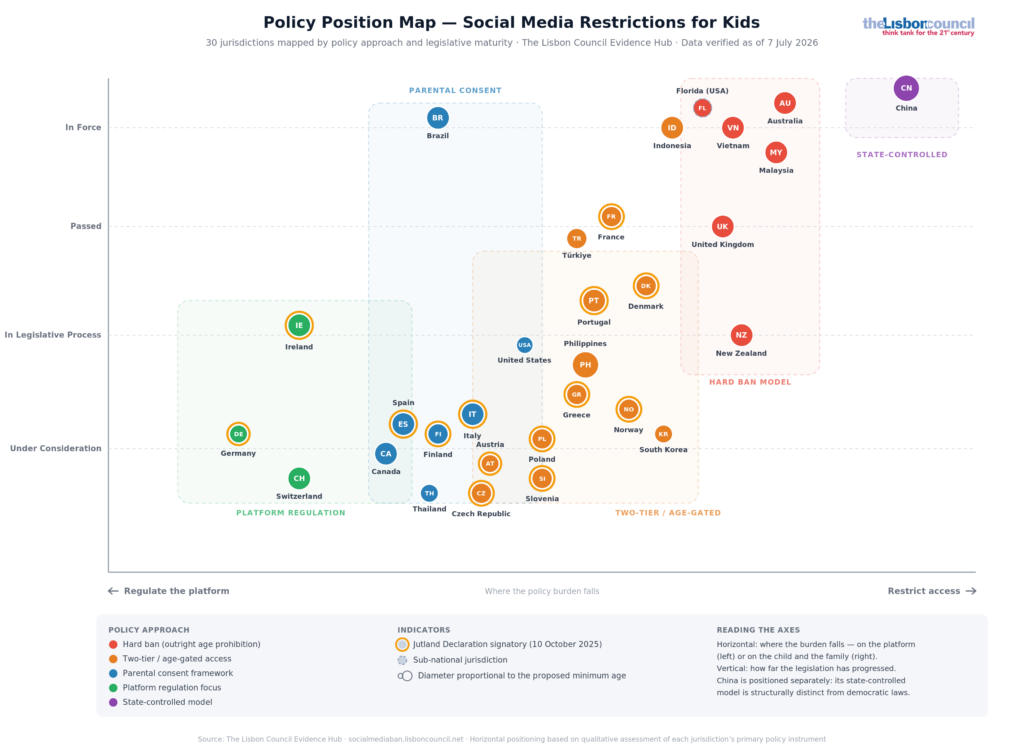
Policy Position Map — Social Media Restrictions for Children. 30 jurisdictions mapped by policy approach and legislative maturity. Data verified as of 06 July 2026.
How to read the map
The horizontal axis — where does the policy burden fall?
The axis spans a single philosophical divide. On the left, jurisdictions place the burden on the platform: safety-by-design duties, digital services act-type obligations, restrictions on engagement-maximising features. On the right, jurisdictions place the burden on the child or the family: age bans, parental-consent gates, and identity verification. Most countries sit somewhere between the two poles. The position is qualitative: an assessment of each jurisdiction’s primary policy instrument, not a measured quantity.
The vertical axis — how far has the legislation progressed?
Four bands, from bottom to top: Under Consideration (debate, government study, working group); In Legislative Process (active bill, committee work, or formal political agreement); Passed (approved by parliament, or by both chambers in divergent versions awaiting reconciliation); In Force (law enacted and being enforced).
Bubble colour — the dominant policy instrument.
Five clusters: hard ban (outright age prohibition), two-tier / age-gated access, parental consent framework, platform regulation focus, and the state-controlled model: a category occupied by China alone, which is positioned separately on the map because its model is structurally distinct from other jurisdiction as its ‘Minor Mode’ operates as a centralised system-wide, and device-level infrastructure and state-curated content . A country may combine elements of more than one approach; the colour reflects the dominant one.
Bubble size is proportional to the proposed (or enacted) minimum age: larger bubbles indicate higher thresholds (16, 17, 18), smaller ones lower thresholds (12, 13, 14).
The gold ring marks signatories of The Jutland Declaration: Shaping a Safe Online World for Minors, adopted in Horsens on 10 October 2025 under the Danish presidency of the Council, 25 European member states (all but Estonia and Belgium), plus Norway and Iceland. The Declaration commits signatories to age verification, safety-by-design and action against dark patterns; it is not, in itself, a uniform age threshold.
A dashed outline marks a sub-national jurisdiction: Florida (US state) is shown alongside national jurisdictions as a case in point, having moved ahead of any US federal law.
Recent developments (May–July 2026)
Updates have been recorded in six jurisdictions: four changes of position.
Malaysia → In Force. The Online Safety Act’s Child Protection and Risk Mitigation Codes came into effect on 1 June 2026, introducing a minimum age of 16 for social media users. This was enforced using eKYC age verification (MyKad or passport), with six months allotted for verifying existing accounts. Following in the footsteps of countries like Australia, Malaysia has become one of the first nations globally to strictly enforce a hard under-16 social media threshold (NBC News; Malay Mail).
United Kingdom → Passed. Following the conclusion of the ‘Growing up in the Online World’ consultation, on 15 June 2026 the British government announced an under-16 ban and is finalising secondary legislation to activate statutory duties under the Children’s Wellbeing and Schools Act 2026. Alongside a total ban on social media for under-16s, the UK is introducing strict restrictions on the functionality of other online services to disable high-risk features such as infinite scroll and engagement-based recommender systems. These design restrictions will also apply by default to 16- and 17-year-olds. Ofcom is drafting the final Codes of Practice to define the high-assurance technical standards required for age verification to enforce the ban and these feature restrictions (GOV.UK).
France — position refined. After the National Assembly’s first-reading vote of 27 January 2026 (130 to 21), the Senate adopted an amended version on 31 March 2026, introducing a two-tier platform classification to be set by ministerial decree; the text has returned to the Assembly for a second reading. The government still aims at enforcement from the September 2026 school year for new accounts (France24; Sénat).
Türkiye → Enacted. The law barring under-15s from social media, passed by parliament on 23 April 2026, was promulgated and published in the Resmî Gazete on 01 May 2026; it enters into force six months after publication, in November 2026 (Resmî Gazete; AP).
Florida — data corrected. The relevant law is HB 3 (2024). Although formally effective from 01 January 2025, it was blocked by a federal preliminary injunction in June 2025 and has only been enforced since late November 2025, when the 11th Circuit stayed the injunction (2–1); First Amendment litigation continues (Central Florida Public Media; Courthouse News).
Brazil and Indonesia → In Force. Brazil’s ECA Digital (Lei 15.211/2025) entered into force on 17 March 2026: accounts for under-16s must be linked to a parent’s account, with mandatory age verification — not, as sometimes reported, an under-12 ban. Indonesia’s PP Tunas (PP 17/2025) took effect on 28 March 2026, with a risk-based scheme: under-16s excluded from high-risk platforms, 13–15-year-olds on medium-risk services with consent, 16–17-year-olds on high-risk services with consent (Senado Federal; Library of Congress; JURIST).
Among the unchanged-but-watched positions: Australia remains the reference point of the In Force / hard-ban corner — with more than five million under-16 accounts removed by March 2026, but also a government warning of “major gaps” in compliance and inquiries opened into Meta, Snapchat, TikTok and YouTube in late March (Euronews); and the European Union sits in In Legislative Process after von der Leyen’s 12 May statement that a “social media delay” proposal could come “this summer,” pending the expert panel’s report due by July (Euronews).
What the map shows
Three patterns stand out.
First, the centre is crowded. Most jurisdictions combine a moderate access restriction with some form of age assurance: two-tier regimes, parental-consent gates and age-gated features. The pure platform-regulation pole, where the burden falls entirely on service design rather than on access, is sparsely populated (Germany, Switzerland, Ireland, and the EU as a body, through the DSA).
Second, the hard-ban corner is filling up from outside Europe. Australia’s model now has two enforcing imitators (Malaysia and, at the state level, Florida, under ongoing litigation) and declared ones (New Zealand, Türkiye from November 2026). No European country has yet adopted it without qualification: Denmark, France, Greece, Portugal and Spain are all converging on two-tier or consent-based variants with thresholds at 15 or 16. The European trajectory, even among Jutland signatories, runs through the centre of the map, not its right edge.
Third, vertical movement is accelerating. Between March and June 2026 alone, four jurisdictions crossed a band boundary. The directions of travel are nearly all upward, towards Passed and In Force, which is consistent with the broader pattern described in the companion article: the policy question across the OECD is no longer whether to act but which instrument to choose.
Method, in brief
The map covers 30 jurisdictions selected for legislative activity on minors’ access to social media. Vertical placement follows the four bands defined above and is based on the formal status of the most advanced relevant instrument in each jurisdiction. Horizontal placement is a qualitative assessment of where the primary instrument allocates the compliance burden; it is reviewed at each revision and is not derived from a quantitative index. Colour reflects the dominant instrument where several coexist. All positions were re-verified against primary sources (legislation, parliamentary records, regulator publications) on 10 June 2026, with a final pass on 06 July 2026.
This blog post appeared on Social Media Ban for Kids, an interactive website managed by The Lisbon Council, a Brussels-based think tank, to gather available evidence and data points on the social media ban for children. Its website is https://socialmediaban.lisboncouncil.net/.
More Analysis
- NBC News, Malaysia enforces ban on social media accounts for children younger than 16
- Malay Mail, Malaysia’s under-16 social media rule starts today: What parents need to know
- Gov UK, Social media to be banned for under-16s in landmark government move to give kids their childhood back
- France 24, Le Sénat vote l’interdiction des réseaux sociaux aux moins de 15 ans, sous conditions
- Sénat, Proposition de loi visant à protéger les mineurs des risques auxquels les expose l’utilisation des réseaux sociaux
- Official Gazette, Presidency of the Republic of Turkey
- AP News, Turkish parliament passes bill to restrict social media access for under-15s
- Central Florida Public Media, Florida gets OK to enforce social media law banning kids under 14
- Courthouse News Service, 11th Circuit renews scrutiny over Florida’s social media ban for minors
- Senado Noticias, ECA Digital, para proteção on-line de crianças e adolescentes, entra em vigor
- Library of Congress, Indonesia: Regulation Introduces Age Restrictions for Social Media Platforms
- Jurist News, Indonesia social media ban for minors comes into effect
- Euronews, Australia warns social media platforms of ‘major gaps’ in under-16 ban enforcement
- Euronews, EU could propose social media ban for children this summer, von der Leyen says