Where Do Experts and Youth Voices Stand on the Proposed Kids Act?
 Giulia Grandin
To provide an immediate, on-the-ground analysis of the new legislative proposal on children’s online safety, the Evidence Lab has gathered rapid-fire expert reactions from leading policy experts and youth representatives. In this blog post, experts Professor Sonia Livingstone, from the London School of Economics and director of Digital Futures for Children; Dóra Dávid, member of the European Parliament (Hungary, EPP) and member of the European Parliament’s Intergroup on Children’s Rights; Francesca Centola, policy and advocacy advisor at Save the Children; Tobiáš Bruno Galia, former youth advisor to president von der Leyen and co-founder and responsible for European affairs at Young Public Affairs Leaders Academy (YPALA); Beatrijs Gelders, senior policy and advocacy officer at COFACE Families Europe; Martina Tóthová, former youth advisor to president von der Leyen and foreign committee member of the Slovak National Youth Council, deliver their initial verdicts, spotlighting what they welcome in the European Commission’s proposal alongside what they see as unaddressed pain points. Find out where leading researchers and advocates stand on the kids act, from the operational feasibility of mandatory safety pre-certifications to concerns over rigid age-gating and data privacy risks.
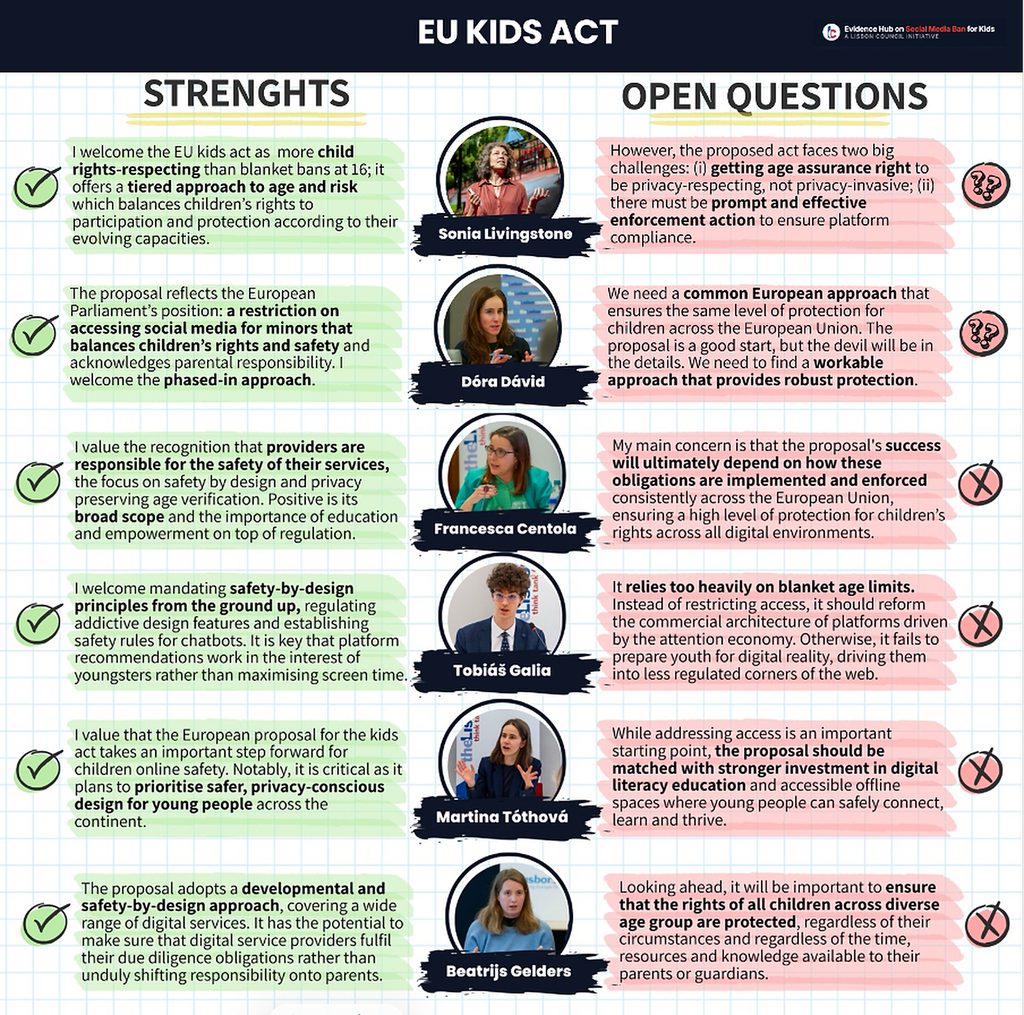
For Professor Sonia Livingstone, the act’s core achievement lies in its refusal to take a blunt approach. She welcomes it as a significantly more child-rights-respecting measure than a blanket ban at the age of 16, precisely because it offers a tiered approach to age and risk, balancing children’s rights to participation and protection according to their evolving capacities. Regarding the unaddressed questions, Professor Livingstone acknowledges the two significant challenges that this complex act faces in achieving real-world impact. The first is ‘getting age assurance right’ so that it respects privacy rather than invading it. The second, and here she points to a cautionary tale already unfolding, is that there must be prompt and effective enforcement action to ensure platform compliance, something which is currently failing in Australia.
Member of the European Parliament, Dóra Dávid welcomes the fact that the Commission’s proposal reflects the Parliament’s position on several issues, including restricting social media access for minors, which balances children’s rights and safety while acknowledging parental responsibility. On this basis, she supports a phased approach to granting minors access to social media. She is less concerned about the mechanism itself than about its consistency across the bloc. She calls for a common European approach to ensure the same level of protection for children throughout Europe. Her closing assessment captures the cautious optimism evident throughout this article: the kids act is a good start, but ‘the devil will be in the details, and the European Union must find a practical approach that provides robust protection.’
From a youth perspective, Tobiáš Bruno Galia strikes a similar note of cautious welcome, but goes further in terms of the ambition of the proposal. He welcomes the shift towards mandating safety-by-design principles from the outset, the regulation of addictive design features such as infinite scroll and autoplay and the establishment of safety rules for artificial intelligence (AI) companions and chatbots. He believes that it is crucial for platform recommendation systems to prioritise the best interests of young users over maximising screen time. However, he argues that the act still relies too heavily on the tool it should be moving away from: age limits and restricting access to digital services. Instead of building ‘walls around birth dates,’ he calls for the priority to be to reform the commercial architecture of platforms driven by the attention economy. He issues a sharp warning about the consequences of access restrictions: blocking access does not eliminate systemic risks; rather, it cuts young people off from vital social infrastructure, including education, informal communities, international solidarity and democratic participation. In his view, this approach fails to prepare young people for the digital world and risks pushing them towards less regulated and far more dangerous areas of the internet.
Another youth voice, Martina Tóthová, views the proposal as a genuine step forward, albeit a partial one. She appreciates that the new proposal prioritises safer, privacy-conscious design for young people, which she values as an important step forward. However, she believes that addressing access is only the beginning. She hopes that the proposal will also be matched with stronger investment in digital literacy education and the creation of accessible offline spaces where young people can safely connect, learn and thrive.
Beatrijs Gelders of COFACE Families Europe highlights and welcomes the proposal’s shift in responsibility. She claims it is positive to see that the kids act proposal adopts a developmental and safety-by-design approach while also covering a wide range of digital services beyond social media. Ms Gelders believes that the proposal has the potential to ensure that digital service providers fulfil their due diligence obligations in creating a safe online environment, rather than ‘unduly shifting responsibility’ onto parents alone. She also notes that the proposal enables parents and guardians to set up supervised ‘mini accounts’ for 13–15-year-olds. She concludes with a note of caution: it will be important to ensure that the rights of all children in the 13–15 age group are protected and respected, regardless of their circumstances and their parents’ or guardians’ time, resources and knowledge.
Francesca Centola of Save the Children welcomes many aspects of the text. ‘There is much to welcome in the kids act,’ she says, ‘particularly its clear recognition that providers remain primarily responsible for the safety of their services, its focus on safety by design rather than relying solely on age-based restrictions, and its provisions on privacy-preserving age verification.’ Ms Centola also welcomes the broad scope of the act, which goes beyond social media, and its acknowledgement that safeguarding children requires a combination of awareness, education, empowerment and regulation. Like Professor Livingstone, her central concern is follow-through: the proposal’s success will depend on how these obligations are consistently implemented and enforced across the European digital rulebook to ensure a high level of protection for children’s rights in all digital environments.
Taken together, these six reactions reveal a common theme: widespread support for a safety-by-design approach and a tiered, rights-based strategy instead of a blanket age ban, coupled with questions on real-life testing. Whether it’s referred to as enforcement (Livingstone and Centola), consistency across Member States (Dávid), commercial architecture (Galia), investment beyond regulation (Tóthová) or equal protection across circumstances (Gelders), this roundup’s message is consistent: the text is an important step, but its real test will be implementation.
This blog post appeared on Social Media Ban for Kids, an interactive website managed by The Lisbon Council, a Brussels-based think tank, to gather available evidence and data points on the social media ban for children. Its website is https://socialmediaban.lisboncouncil.net/.